
Failed Part of Your 2391-52 Assessment? Here's What Happens Next
The City & Guilds 2391-52 Initial and Periodic Inspection and Testing qualification is widely regarded as one of the most challenging electrical qualifications available. It tests both your technical knowledge and your ability to apply that knowledge in realistic inspection and testing situations.
If you've recently received a result and discovered that you haven't passed one section, don't panic.
One of the biggest misconceptions surrounding the 2391-52 is that failing a single assessment means you must complete the entire qualification again. In reality, City & Guilds assess the qualification through several separate components, and in most circumstances you only need to retake the part that you didn't pass.
For the latest qualification information, visit the official City & Guilds qualification page:
City & Guilds 2391 Initial and Periodic Inspection and Testing
Understanding the Four Assessment Components
The 2391-52 is designed to assess whether you can inspect, test, verify and certify electrical installations safely and competently.
Each assessment element focuses on different skills.
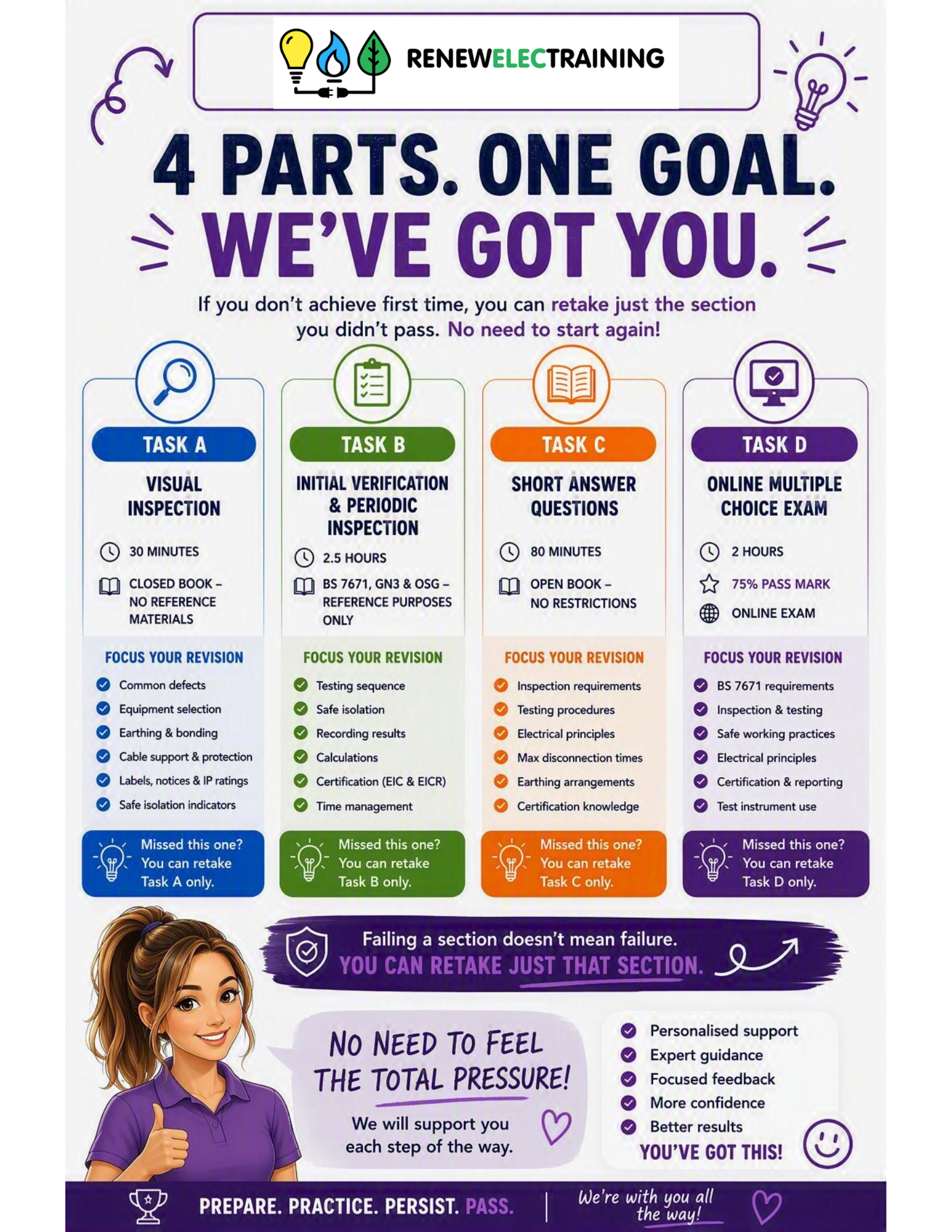
At Renew Elec Training Sam and Alex will be there to help every step of the way and all of our tutors are gold card electricians and here to help you to success.
Task A: Visual Inspection
Assessment Conditions
Closed book
No reference materials permitted
30 minutes
What You Are Expected To Do
During the visual inspection task, you are presented with an installation containing a number of defects, non-compliances or potential safety concerns.
Your job is to identify as many issues as possible and record them accurately.
Common Areas Learners Miss
Incorrect IP ratings
Missing labels and notices
Poor cable support
Inadequate mechanical protection
Incorrect earthing and bonding arrangements
Incorrect accessories or equipment selection
Signs of damage or deterioration
C1, C2 and C3 confusion
How To Revise
The best preparation is exposure to real installations. Spend time carrying out genuine visual inspections rather than simply reading guidance notes.
Focus on:
BS 7671 inspection requirements
Common electrical defects
Consumer units
Earthing and bonding
Identification of dangerous situations
Many candidates lose marks because they rush. A structured approach usually produces better results than trying to spot defects randomly.
Task B: Initial Verification and Periodic Inspection
Assessment Conditions
BS 7671 permitted
Guidance Note 3 permitted
On-Site Guide permitted
Reference purposes only
2.5 hours
What You Are Expected To Do
This is often considered the most demanding part of the qualification.
You'll be required to:
Inspect the installation
Carry out testing safely
Record results accurately
Identify defects
Complete certification correctly
You'll normally undertake tests such as:
Continuity of protective conductors
Ring final circuit continuity
Insulation resistance
Polarity
Earth fault loop impedance
RCD testing
Prospective fault current
Why Candidates Fail This Section
Most failures occur because of:
Incorrect testing sequence
Calculation errors
Recording results incorrectly -See this article about how to practice with paper IET model forms.
Certification mistakes
Poor time management
Missing observations
Often the practical testing itself is acceptable, but marks are lost when results are transferred onto paperwork incorrectly.
How To Revise
Practice completing:
Electrical Installation Certificates (EICs)
Electrical Installation Condition Reports (EICRs)
Schedules of inspections
Schedules of test results
Focus heavily on:
Safe isolation
Testing sequence
Understanding expected results
Use of test instruments
The more certificates you complete before assessment day, the more comfortable the task becomes.
Task C: Short Answer Questions
Assessment Conditions
Open book
BS 7671 permitted
Guidance Note 3 permitted
On-Site Guide permitted
No restrictions
80 minutes
What You Are Expected To Do
This section assesses your understanding of inspection and testing principles.
You'll usually encounter questions relating to:
Electrical science
Testing procedures
Inspection requirements
Certification
Maximum disconnection times
Earthing arrangements
Protective devices
BS 7671 requirements
Common Mistakes
Many candidates assume that because the assessment is open book it will be easy.
Unfortunately, there often isn't enough time to continually search through the regulations for every answer.
Successful candidates generally know where information is located and use the books to confirm answers, not to find every answer from scratch.
How To Revise
Become familiar with:
BS 7671 structure - book onto the latest 18th Edition course here.
Appendices
Testing procedures in Guidance Note 3
Key inspection requirements
Typical examination calculations
Practice locating information quickly rather than reading the books cover to cover.
Task D: Online Multiple-Choice Examination
Assessment Conditions
Online multiple-choice assessment
2 hours duration
75% pass mark required
What You Are Expected To Know
The online examination assesses your underpinning knowledge of inspection and testing and your understanding of the requirements within BS 7671.
Questions can cover areas such as:
Initial verification
Periodic inspection and testing
Safe isolation procedures
Earthing arrangements
Protective devices
Electrical principles
Certification and reporting
Inspection procedures
Test instrument use
BS 7671 requirements
Guidance Note 3 principles
Unlike the practical assessments, this exam focuses on your knowledge and understanding rather than demonstrating practical testing skills.
Why Candidates Fail This Section
Many candidates underestimate the depth of knowledge required because it is a multiple-choice examination.
Common reasons for failing include:
Insufficient revision of BS 7671 requirements
Weak understanding of inspection and testing principles
Confusion between initial verification and periodic inspection procedures
Poor knowledge of certification requirements
Relying on experience rather than the requirements of the regulations
How To Revise
The most successful candidates:
Complete practice questions and mock examinations
Revise key inspection and testing terminology
Understand why each test is carried out
Familiarise themselves with common calculations and expected test results
Review BS 7671 and Guidance Note 3 regularly during preparation
Remember, a 75% pass mark means solid preparation is essential. A good understanding of inspection and testing principles will make both the online examination and the practical assessment significantly easier.
Can You Retake Just One Part?
Yes.
One of the biggest myths surrounding the 2391-52 is that if you fail an assessment, you must complete the entire qualification again.
In reality, the qualification is broken down into separate assessment components:
Task A: Visual Inspection
Task B: Initial Verification and Periodic Inspection Practical Assessment
Task C: Short Answer Written Assessment
Task D: Online Multiple-Choice Examination
If you are unsuccessful in one of these elements, you can normally resit only that specific assessment rather than repeating everything.
For example:
Pass Tasks A, B and C but fail the online exam? Retake the online exam.
Pass the online exam but fail the practical inspection and testing assessment? Retake the practical assessment.
Fail the visual inspection only? Retake the visual inspection.
This approach allows candidates to focus their revision on the specific area where they lost marks, making the resit process much less daunting.
A Final Word
At Renew Elec Training, we regularly support electricians who have fallen short in one section of the 2391-52. The important thing to remember is that a failed assessment is not a reflection of your ability as an electrician.
Many competent electricians require a second attempt, particularly if they have not sat formal examinations for many years or have limited experience completing certification and inspection reports.
Treat the feedback as a roadmap rather than a failure. Identify the area that needs improvement, revise the relevant topics, and return to the assessment with confidence.
In most cases, you're much closer to a pass than you think